
Locals Urged to Report Koala Sightings on Wildlife Page

In Greenslopes, a suburb defined by major health facilities, busy arterial roads and urban parkland, koalas are not the first thing that come to mind. Yet publicly available sighting records show a citizen sighting has been reported in the suburb and more recently, others in the surrounding suburbs.


Several of those records appear in citizen-science databases, where residents log wildlife sightings with dates, locations and often photographs. The iNaturalist place page for Greenslopes includes a 2024 koala observation among the species recorded locally. It also records several more recent observations in neighbouring suburbs. These platforms do not measure population size, and multiple entries may relate to the same animal. However, they do provide verifiable evidence that koalas have been observed within the broader inner-south landscape.

Photo Credit: iNaturalist — Greenslopes

Queensland’s environment department also runs an official reporting pathway via the QWildlife app and publishes an interactive dashboard of reported koala sightings. The department’s guidance makes it clear that sightings are not a population survey, and that multiple reports may relate to the same animal. However, reporting helps build a clearer picture of when and where koalas are seen. 

If you want the government reporting channel, start at Queensland Government — Report koala sightings and read the caveats at QWildlife FAQs.

Reading the maps without overreading them

It’s important not to over-interpret a handful of pins on a map. A koala record in a suburb doesn’t automatically mean koalas are “back” in a stable, breeding way, especially in highly built-up areas. 

What these databases can do well is show where people are encountering koalas, and where repeated reports might justify extra attention: safer road design, habitat restoration, or community education.

This context matters because koalas in Queensland, New South Wales, and the ACT are listed as Endangered under national environmental law. That listing reflects broad, long-term pressures (especially habitat loss and fragmentation) and is a reminder that even small local actions that reduce injury and mortality can be meaningful. 

What makes a suburb risky for koalas?

Across urban Australia, two commonly cited risks for koalas moving through suburbs are vehicle strikes and dog attacks. In the inner-south, where roads are frequent and traffic volumes can be high, managing collision risk is a practical issue — not an abstract one.

Brisbane has already debated measures such as fencing and speed limits in other koala-adjacent areas. For example, koala fencing and speed limit changes on Boundary Road and the public discussion around whether those measures are sufficient. 

There is also local government documentation showing that “where strikes happen” can be mapped and assessed. A Brisbane City Council tabled paper (PDF) examines koala roadkill mitigation options around a reserve area and includes analysis intended to inform decision-making. 

The practical implication is straightforward in Greenslopes. If koalas are recorded in the wider inner-south, some will occasionally travel on the ground between trees, which can bring them into contact with roads, especially near connected green spaces and drainage lines.

What’s happening locally: habitat work along 

Greenslopes sits within the Norman Creek catchment, which includes pockets of parkland and creekside vegetation that support a range of wildlife. One active on-the-ground effort is habitat restoration at Greenslopes DCP, led by theNorman Creek Catchment Coordinating Committee. Their project pages describe weed control and revegetation activities to improve local habitat conditions.

It’s not necessary to label every restoration site “koala habitat” to recognise the broader benefit: healthier, better-vegetated creek corridors can improve urban biodiversity and provide more shade and canopy connectivity for many native species.

Photo Credit: Unsplash

What Greenslopes locals can do 

You don’t need specialist gear to contribute. The most useful steps are the ones that improve records and reduce risk.

1) Report sightings through trusted channels.

If you see a koala, lodge a report via Queensland Government — Report koala sightings or add a record to iNaturalist — Greenslopes. Where safe and appropriate, a photo can help verification — but don’t put yourself (or the animal) at risk for it.

2) Support local habitat restoration.

If you have time to spare, keep an eye on volunteer opportunities. Weed removal and planting days are practical, local ways to strengthen habitat quality.

3) Add native plants at home if you have space.

Backyard trees and shrubs can help connect habitat patches. Brisbane’s Free Native Plants program is a low-cost way to start, especially for renters and small gardens.

4) Drive cautiously near green spaces at night and early morning.

If you’re travelling near parks or creek lines after dark or around dawn, slow down and scan the road edges. Cautious driving reduces collision risk for all wildlife, not just koalas.


Greenslopes doesn’t need to become a wilderness to play a role in conservation. But the publicly available data suggests it’s worth paying attention. Recording sightings, restoring habitat where possible, and reducing avoidable risks are all within reach for an ordinary suburb.

Published 12-Feb-2026

Waterway Revival: What Hanlon Park Means for Greenslopes

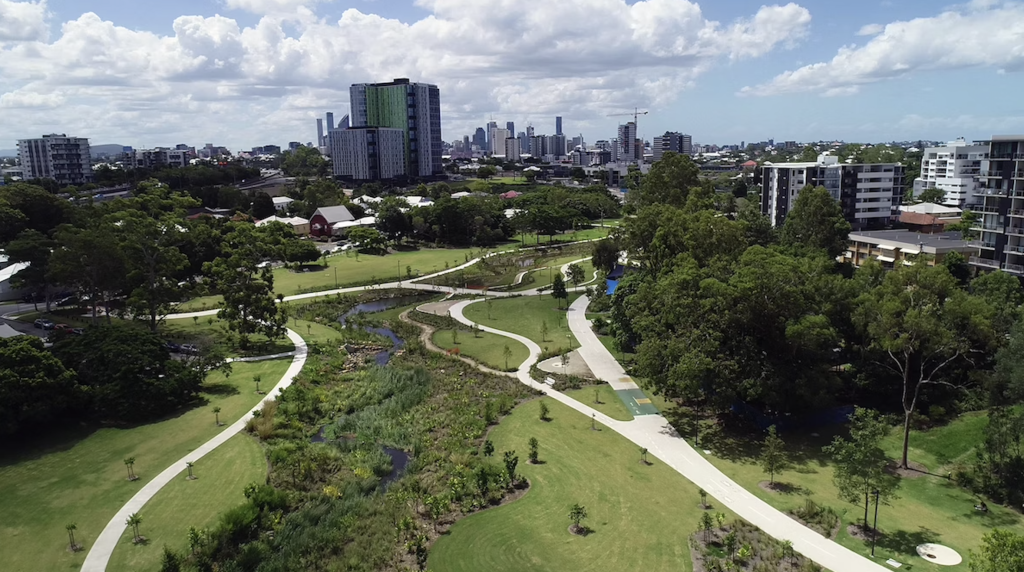
More than a decade ago, Brisbane adopted the Norman Creek 2012–2031 Catchment Master Plan — an ambitious, long-term vision to restore one of the city’s most heavily urbanised waterways. Part of that transformation involves Hanlon Park / Bur’uda, a once-concrete drainage corridor that has become a green, thriving community space and a flagship example of what the master plan set out to achieve.


At the centre of that transformation is Hanlon Park / Bur’uda, a once-concrete drainage corridor that has become a green, thriving community space and a flagship example of what the master plan set out to achieve.

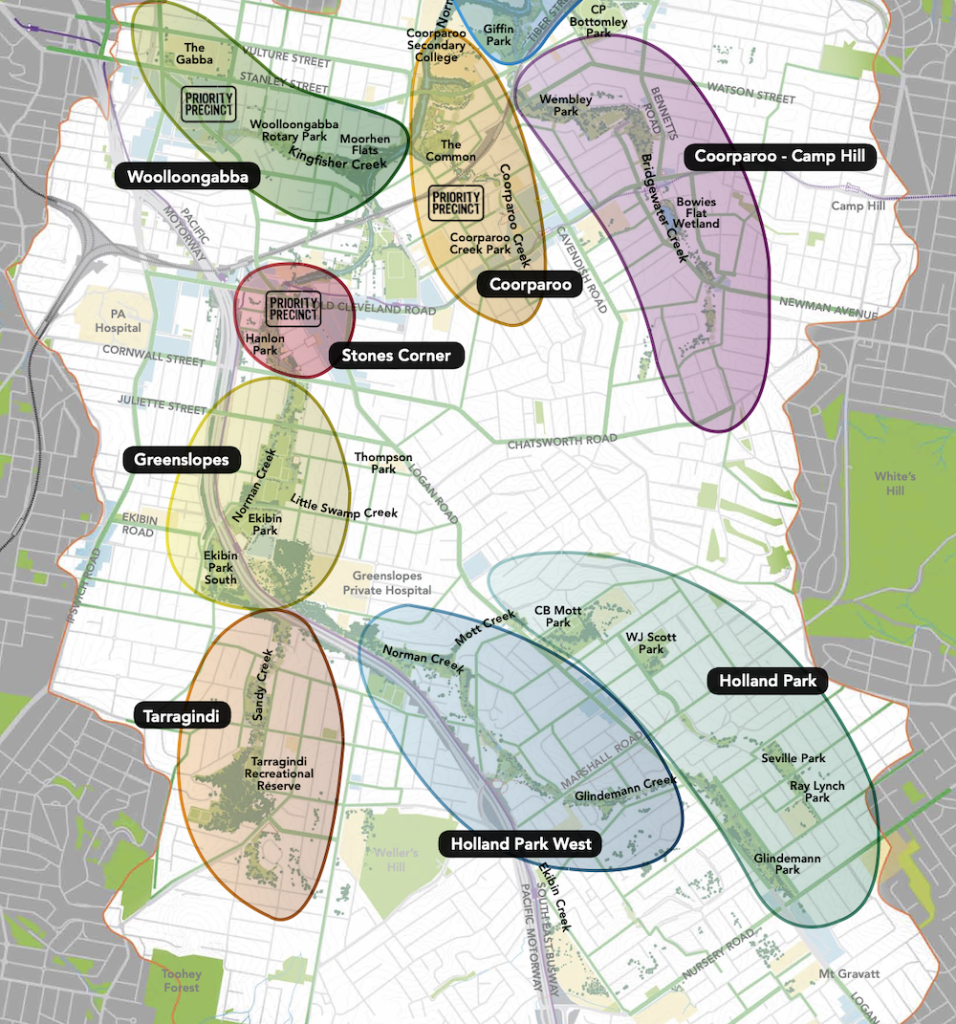
The Norman Creek Catchment Master Plan was launched in 2012 as a 20-year strategy to reconnect people, parks and neighbourhoods with the creek system stretching from Toohey Forest to the Brisbane River. Rather than focusing on isolated upgrades, the plan aimed to rehabilitate the entire catchment — improving water quality, restoring habitat, managing flood risk and creating accessible, high-quality public spaces.

Hanlon Park / Bur’uda: a project delivered and celebrated

Completed and opened to the public in 2022, Hanlon Park / Bur’uda represents one of the master plan’s most significant achievements to date.

Where a cracked concrete channel once rushed stormwater downstream, a naturalised, meandering creek now flows through the park. Hundreds of native trees and tens of thousands of shrubs and groundcovers were planted, creating habitat, shade and cooler conditions. Walking and cycling paths, picnic areas and a nature-based playground have transformed the park into a daily destination for families, commuters and local workers.

The project also delivered vital flood resilience, allowing water to spread and slow during heavy rain rather than surge through a narrow channel. Early ecological monitoring has shown a sharp increase in fish numbers and species diversity, demonstrating that nature is returning to the heart of the suburb.

Hanlon Park / Bur’uda has also received multiple awards and professional recognition, celebrating its excellence in design, sustainability and urban waterway transformation. These awards acknowledge the project’s innovative approach to combining landscape architecture, ecological restoration and community amenity — putting the site on the map as a national benchmark for urban creek rehabilitation.

Beyond Hanlon Park: what else has been achieved

Hanlon Park is not an isolated success. Across the catchment, the master plan has already delivered:

  • Coorparoo Creek Park works, helping daylight sections of the creek and create new green space within a growing urban centre
  • Upgraded walking and cycling links along Norman Creek and connecting suburbs
  • Extensive revegetation and weed management, much of it supported by community volunteer groups
  • Improved stormwater management, reducing pollution entering the creek system

These projects collectively reflect the plan’s core idea: that waterways are not just infrastructure, but social, ecological and cultural assets.

Where we are now in 2026

With several major projects delivered, the Norman Creek program has entered a consolidation and next-stage planning phase.

Council is currently progressing concept planning and community engagement for remaining priority areas, including parts of Kingfisher Creek, Woolloongabba and upstream Greenslopes precincts. These works focus on improving connectivity, expanding habitat corridors and ensuring future developments respond better to flooding and heat.

Importantly, the master plan was never intended to be static. It allows projects to be delivered as funding, partnerships and redevelopment opportunities arise — meaning progress can be steady rather than rushed.

What to expect next

Over the coming years, residents can expect:

  • Further design work and consultation on remaining creek precincts
  • Incremental construction tied to funding and redevelopment timelines
  • Continued community involvement, particularly through local catchment and “Friends of” groups
  • Ongoing monitoring of water quality, biodiversity and flood performance

For communities like Greenslopes, this means change will continue — but in manageable stages, with visible benefits along the way.

Why it matters locally

The transformation of Norman Creek has already changed how people move through, use and value their local environment. Safer paths, cooler green spaces, improved flood resilience and richer biodiversity all contribute to a healthier, more liveable suburb.


As the master plan moves toward its final years, projects like Hanlon Park / Bur’uda stand as proof that long-term planning, backed by community support, can reshape even the most engineered urban landscapes.

Published 31-Dec-2025

Greenslopes Teen Arrested After Mounted Unit Responds During Brisbane Christmas Patrol

A 17-year-old Greenslopes boy has been arrested in Brisbane’s CBD after Queensland Police’s Mounted Unit moved from a festive Christmas patrol into an operational response during the Commissioner’s Christmas carols.


Police said the incident unfolded about 1.30 p.m. on 2 December, when officers were called to a fast-food restaurant on Queen Street, Brisbane City, following reports of an alleged assault and disturbance. The teenager allegedly fled the scene on foot before general duties officers arrived.

At the time, officers from the Queensland Police Service Mounted Unit were patrolling nearby as part of the Commissioner’s Christmas concert, with police horses dressed in Christmas-themed gear and engaging with the public.

When the call for assistance was received, the Mounted Unit transitioned from ceremonial duties to an operational role, moving through the CBD streets and tracking the teenager.

Police said the boy was located and arrested at the intersection of Albert and Turbot streets without further incident.

The Greenslopes teenager has been charged with one count of assault occasioning bodily harm and appeared before Brisbane Children’s Court.

Police said the incident highlighted the Mounted Unit’s operational capability, noting their elevated vantage point and mobility in crowded urban environments, even during community and ceremonial events.


Published 8-Dec-2025

Greenslopes Revisits 1985: A Throwback to Abortion Debates

Did you know that Greenslopes was at the heart of the state’s fierce abortion debate in 1985 and the events of that year shaped the Termination of Pregnancy Bill?


A Step Back in Time

The political landscape in Queensland was vastly different in the 1980s. Then Premier Sir Joh Bjelke-Petersen had ordered police raids on abortion clinics throughout the state, as the termination of pregnancy was illegal under Queensland law. Those laws remained unchanged for over a century.

The Women’s Centre at Red Hill in Brisbane was offering all-options counselling and referring women to abortion clinics in Sydney when the abortion debate first gained prominence. The violent attacks that followed – bricks thrown through windows – brought significant attention to their work and gave Queensland women a sense of choice.

During this time, Greenslopes was home to one of Queensland’s abortion facilities, the Greenslopes Fertility Control Clinic, which began providing services in the late 1970s. However, under Mr Bjelke-Petersen’s leadership, the government was determined to put an end to what they saw as “abortion on demand.”

In 1980, former Liberal MP Rosemary Kyburz played a pivotal role by leaking details of proposed laws that aimed to ban abortion in all circumstances except when a woman’s life was at imminent risk. She vehemently opposed these laws, describing them as “the most frightening piece of fascist legislation I have ever seen in my life.” Despite personal attacks and threats, including the shooting of her dog, Ms Kyburz stood her ground.

Clinics Raided

In the midst of this heated debate, Queensland police launched Operation Lost Cause in May 1985. More than 50 officers conducted simultaneous raids on known abortion clinics in Brisbane, Townsville, and the Greenslopes Fertility Control Clinic. A total of 47,000 patient files were seized during these raids.

Dr. Peter Bayliss, who operated the Greenslopes facility, faced arrest and charges under the criminal code. Eventually, he was found not guilty, and the judge, Fred Maguire, ruled that abortion was effectively legal if performed to prevent a serious threat to a woman’s health.

The fallout from these events resulted in a highly divisive public debate, leaving Queenslanders divided on the issue of abortion.

A New Future

In 2018, Greenslopes and all of Queensland revisited their history as the state’s Parliament debated the decriminalization of abortion and its removal from the criminal code. The long-standing debate has polarized opinions and ignited passionate arguments on both sides.

In a significant victory for women’s rights, Queensland’s Parliament voted to legalise abortion and remove a 119-year-old “morality” section from the state’s criminal code. After decades of passionate debate, the historic moment was marked by cheers in the legislative assembly chamber, ending a 50-year struggle by women’s groups in a state historically known for its conservatism. 


Abortion had been classed as an “offence against morality” under the outdated criminal code, a law written before women had gained the right to vote. Both major political parties, Labor and the Liberal National party, allowed their members a conscience vote, and ultimately, the laws passed with a 50-41 vote.

The legislation legalised abortion up to 22 weeks gestation and beyond with the approval of two doctors, while also establishing safe access zones around clinics to protect women from harassment.

Published 14-Nov-2025. Originally published 14-Oct-2023

Mourning Roast Coffee Shop in Greenslopes Continues to Brew Community Spirit Since 2024

Greenslopes residents have enjoyed the unique offerings of Mourning Roast on Logan Road since its opening in 2024. This coffee spot was established by experienced coffee professionals Sam and Nadine to foster a strong neighbourhood hub centred around the daily ritual of enjoying quality coffee.


From its inception, Sam and Nadine, the owners, envisioned their establishment as more than just a place for a caffeine fix. They strived to make it an integral and continuously evolving part of the Greenslopes community.

A Sustained Ritual for Coffee Enthusiasts

Since its launch in 2024, Mourning Roast has continued its mission to elevate the everyday coffee experience for its patrons, encouraging them to take a moment to pause and appreciate life’s simple pleasures with each visit.

The owners have consistently conveyed their goal of making a trip to their shop feel like a significant daily ritual, nurturing connection and a sense of indulgence within the local area. Their commitment to crafting an experience transcending the ordinary cup of coffee has remained a central tenet of their business.

Consistent Quality in Blends and Treats

Since opening in 2024, the coffee shop has maintained its offering of a custom coffee blend that provides smooth flavours with hints of cacao, caramelised cherry, and brown spice. The blend is consistently designed to have a lingering richness suitable for both long blacks and flat whites.

Besides their signature blend, Mourning Roast has continued serving cold and batch brew options. The concise menu of takeaway food items, including toasties, croissants, white chocolate and macadamia brownies, cinnamon rolls, Caramilk pavlova Rocky Road, and a carrot cake-inspired shortbread jam drop, has also remained a popular choice for locals since the shop’s introduction.

Furthermore, their commitment to featuring a dark roasted signature blend with notes of dark chocolate, brown sugar, and toasted almonds, alongside rotating single-origin selections from small-batch Australian roasters, has been a consistent feature since 2024.  

Ongoing Commitment to Community

Since 2024, founders Sam and Nadine have continued to operate Mourning Roast with the initial passion that stemmed from their shared love for coffee and an appreciation for alternative culture. Their ongoing focus has been maintaining a space that reflects their tastes and provides a welcoming environment for like-minded individuals.

Their vision has consistently extended beyond simply serving coffee; they remain dedicated to nurturing a strong sense of community and belonging within their shop. The owners have strived to ensure that their establishment remains a place where coffee is central, with the aim that every cup continues to contribute to the local narrative.

Sustained Positive Community Feedback

Since its opening in 2024, Mourning Roast has continued to receive positive feedback from the Greenslopes community. Reports still indicate consistent praise for the quality of the food and coffee, the staff’s friendliness, and the establishment’s overall atmosphere. It continues to be noted as a convenient location for night shift workers seeking a place to unwind.

Specific items like the lavender matcha and the large biscuit have maintained their positive reputation. The availability of unique items such as “Sinnerbuns” and the Jerk on Turk specialty toasted sandwich continues to highlight their commitment to offering more than just standard cafe options.


Enduring Design and Atmosphere

The design of Mourning Roast, which merges a refined aesthetic with a touch of rebellion, creating a sanctuary where modern architecture meets luxe gothic design elements, has remained a consistent aspect of the shop since its 2024 opening.

This unique atmosphere continues to contribute to the overall experience that Sam and Nadine aimed to provide their customers from the outset.

Published Date 14-May-2025

Greenslopes Student Earns Spot in Metropolitan East AFL Team

A Greenslopes State School student has been selected for the Metropolitan East AFL team, earning the opportunity to compete at the upcoming Queensland State Championships.


Greenslopes Student to Represent Metropolitan East

Gabby from Greenslopes State School has been selected to join the Metropolitan East AFL team, an accomplishment that highlights her dedication to school sport. Her achievement is the result of consistent effort and a strong commitment to developing her skills.

Gabby will now represent Metropolitan East at the Queensland State Championships in June. She will be competing against selected student athletes from across the state.

About Metropolitan East and School Sport

Metropolitan East is among the twelve regions established to oversee representative school sports across Queensland. It covers an area from the Bay Islands in the east to Logan City in the south, including suburbs around the Brisbane River and the M1 corridor.

Greenslopes State School is part of the Mount Gravatt District, one of several districts within Metropolitan East. Students from affiliated schools, regardless of their school system, are eligible to trial for selection into regional teams such as AFL. Selection for a Metropolitan East team is highly competitive and considered a significant achievement.

Greenslopes Community Applauds Achievement

Gabby’s selection has been celebrated within the Greenslopes State School community. Many offer messages of congratulations and support on social media. Her achievement stands as an example of how perseverance and a positive attitude can lead to opportunities.

Commitment Behind the Success


Gabby’s journey to selection reflects countless hours of hard work. Greenslopes State School acknowledged her dedication to personal improvement and her enthusiasm for Australian football. With her place secured, Gabby will focus on preparing for the Queensland State Championships. She will represent both her school and her region with pride.

Published 28-Apr-2025

Legacy House for Veterans Takes Shape in Greenslopes

For many war veterans and their families, the journey home doesn’t end with service. To honour their valor and service, a new facility called Legacy House is being built in Greenslopes to ensure that they receive the support they need to rebuild their lives. 


Construction is progressing at the Greenslopes facility designed to provide much-needed support to veterans and their families. The new centre, set within the Greenslopes Hospital Precinct, will bring together key veteran support organisations under one roof, making access to care simpler and more effective for families facing complex challenges.

A Community-Driven Approach to Veteran Care

Legacy House is being developed as part of a collaborative model of care, informed by extensive Australian and international research on veteran welfare. The facility will connect Legacy Brisbane, RSL Queensland, Mates4Mates, and Open Arms with essential medical and mental health services, including the Keith Payne VC Mental Health Unit, Greenslopes Private Hospital, and Gallipoli Medical Research Foundation.

With veterans returning from Australia’s longest military engagement in Afghanistan, the need for ongoing care remains high. Many families continue to navigate mental health struggles, PTSD, and other service-related conditions, making it crucial to have a single, accessible support hub that focuses not only on veterans but also on their loved ones.

Legacy Brisbane CEO Brendan Cox, a former Australian Infantry member, has drawn insights from his research into veteran care, finding that the current system is fragmented and difficult to navigate. The Royal Commission into Defence and Veteran Suicide has reinforced these concerns, calling for a more coordinated and family-focused support structure—something Legacy House aims to deliver.

Legacy House in Greenslopes
Photo Credit: Legacy House Australia

Designed for Families, Built for the Future

The new two-storey building at Greenslopes will feature spaces that balance privacy with collaboration, ensuring veterans and families receive both individual care and community support. The design has been influenced by the site’s historical significance, paying tribute to the original Red Cross Building that served military personnel during World War II.

Inside, families will have access to counselling, social support, and specialised case management services, tailored to meet the evolving needs of modern veteran households. A particular focus will be on mental health support for families of incapacitated veterans, acknowledging the significant impact that military service has on loved ones.

Strong Support from the Community

Funding for Legacy House is being driven by the Bring It Home campaign, which has already secured $3 million, thanks to contributions from the Queensland Government, Australian Government – Department of Veterans’ Affairs, Hancock Prospecting, BMD Group, and various private donors. Legacy Brisbane is working to raise an additional $1.5 million to complete the project.

Prominent figures in the veteran and business communities have backed the initiative, including Tim Fairfax AC and Gina Fairfax AC, as well as former defence leaders such as General Sir Peter Cosgrove and Lieutenant General Rick Burr. Their support reflects a shared commitment to ensuring veterans and their families receive the care they need long after their service ends.

Completion of construction is expected by mid-2026. Once operational, it will provide a long-term, sustainable solution for veterans and their families, ensuring they have access to comprehensive, wraparound support in one location.


For more information, visit bringithome.org.au or contact Legacy Brisbane at (07) 3029 5600.

Updated 20-February-2025. Published 13-February-2025

Police Operation in Greenslopes Leads to Three Teen Arrests

Residents of Greenslopes witnessed a significant police operation on Tuesday when specialist officers converged on Juliette Street after tracking an allegedly stolen vehicle from the Gold Coast.

The Public Safety Response Team (PSRT) was called to the Greenslopes location at approximately 9:40am when a black Ford Ranger, reportedly stolen from Varsity Lakes on March 16, was detected in the area.

Greenslopes locals captured footage of the police response as officers took three teenagers into custody at the suburban address. The arrest occurred without incident, though it brought unusual police activity to the normally quiet street.

This incident marks another example of Greenslopes being impacted by Queensland’s growing vehicle theft problem. State statistics reveal car theft has doubled over the past decade, with almost 7,000 insurance claims totalling $113 million last year—exceeding numbers in the more populated New South Wales.

None of the charged teenagers are Greenslopes residents. The suspects include a 16-year-old from Coomera, a 15-year-old from Pacific Pines, and a 15-year-old from Forest Lake, facing various charges including unlawful use of a motor vehicle and entering premises to commit offences.

As the case proceeds through the Children’s Court system, Greenslopes residents are left to consider the implications of their neighbourhood becoming one of many Brisbane suburbs affected by vehicle theft issues that continue to challenge law enforcement across Queensland.

Published 18-March-2025

Greenslopes Medical Precinct Approved Despite Opposition from Private Hospital

A new medical precinct planned for Greenslopes has been granted approval, despite legal opposition from the operator of Greenslopes Private Hospital. The development, located at 68-72 Hunter Street, will introduce a multi-storey healthcare facility with extensive medical and community care services.


The proposal by Ron Build Pty Ltd sought approval for a material change of use to establish a community care centre and healthcare service on land opposite Greenslopes Private Hospital. The BCC approved the development, but the decision faced an appeal from Ramsay Health Care Australia Pty Limited, the operator of the private hospital.

Ramsay Health Care argued that the new precinct duplicated existing medical services and was not complementary to the hospital’s operations. However, the Planning and Environment Court of Queensland dismissed these concerns, ruling that the development complied with the Coorparoo and Districts Neighbourhood Plan Code.

Judge Amanda McDonnell determined that competition does not negate complementarity, reinforcing that the precinct would serve the local community’s growing healthcare needs.

New Medical Infrastructure for Greenslopes
Photo Credit: DA/A006236443

Project Details: New Medical Infrastructure for Greenslopes

The approved Greenslopes Medical Precinct (DA A006236443) will replace three residential dwellings and a cafe, transforming the site into a modern, multi-level healthcare facility designed by Gray Puksand. The key features include:

  • Three-storey building with a gross floor area of 4,783 sqm
  • Three basement levels accommodating 123 car parking spaces and 18 bicycle spaces
  • Two-hour free parking for patients and secured parking for medical specialists
  • An on-site ambulance bay for rapid emergency responses
  • Tenancy spaces for various health services, including community care, allied health, and general practitioners

The building’s facade will feature landscaping, minimising visual bulk and enhancing integration with the existing streetscape.

Community and Economic Need for the Project

The ruling highlighted the growing demand for healthcare services in Greenslopes, with many medical practitioners already residing in the area. The decision was influenced by:

  • Population growth and the increasing ageing demographic in the local catchment
  • The proximity to Greenslopes Private Hospital, creating a cluster of health services
  • The importance of accessibility, with the site providing walkable healthcare options

The court noted that co-locating medical services benefits the community, ensuring a wider range of options while supporting competition and patient choice.

Ramsay Health Care’s Opposition and Legal Challenge

Ramsay Health Care opposed the development on the grounds that it constituted an overdevelopment of the site and would compete with existing hospital services. However, expert evidence presented in court determined that:

  • The building height, bulk, and scale aligned with the local planning framework
  • The Greenslopes Private Hospital would remain the dominant medical facility in the area
  • The new precinct would not delay hospital expansion plans or impact existing operations

The court ultimately ruled in favour of the development, allowing it to proceed subject to conditions.

Next Steps: Construction Timeline and Future Developments

With legal obstacles removed, construction of the Greenslopes Medical Precinct is expected to begin next year. The project represents a major expansion of medical infrastructure in the area, reinforcing Greenslopes as a key healthcare hub in Brisbane.


Despite initial opposition, the development is set to enhance healthcare accessibility, providing a range of medical services to meet growing community needs.

Published 28-Feb-2025

Coorparoo RSL’s Revamp of Greenslopes Bowls Club Underway

Construction is set to begin at the former Greenslopes Bowls Club site as Coorparoo RSL embarks on a major refurbishment to revitalise the long-closed community venue. The redevelopment aims to restore the site as a family-friendly space featuring a restaurant, live music, and social bowling greens.


Once a thriving hub for live music, community events, and social bowls, the Greenslopes Bowls Club at 131 Ridge Street officially closed in late 2022. In response to concerns over the loss of vital community spaces in the area, BCC opened the site for tender in 2023, seeking a non-profit organisation capable of restoring and managing the venue.

Coorparoo RSL and Community Club was chosen as the preferred leaseholder and, in September 2023, secured a 10-year lease agreement with BCC. The agreement also includes an option to extend the lease after three years.

The Redevelopment Plan and Timeline

Coorparoo RSL is investing $3.5 million into the site’s refurbishment, partnering with Paynters, a hospitality design and construction firm, to deliver the transformation.

The project will include:

  • A bistro, bar, and café to cater to families and visitors.
  • Two bowling greens, one dedicated to social bowls and the other as a community green space.
  • An outdoor covered deck for dining and entertainment.
  • Expanded parking facilities to accommodate visitors.
  • Gaming facilities as part of the club’s operations.
  • A welfare office to support veterans, aligned with RSL Queensland’s mission.

The staged refurbishment timeline is as follows:

  • February 2025 – Worksite establishment.
  • March 2025 – Removal of building materials.
  • April 2025 – Commencement of the refurbishment fit-out.
  • Second half of 2025 – Expected project completion and relocation of Coorparoo RSL operations to the site.
Greenslopes Bowls Club
Photo Credit: CrFionaCunningham/Facebook

Community Sentiment and Future Impact

The project has received strong support from Coorparoo RSL members and the wider Greenslopes community. Club president Mervyn Cuylenburg expressed optimism, stating that the redevelopment would restore a key social space while securing the club’s long-term future.

BCC’s decision to lease the site to Coorparoo RSL has also reassured residents concerned about the land being sold for private development. Many locals have welcomed plans to reintroduce live music, dining, and recreational activities to the area.

Next Steps

Coorparoo RSL has assured members and residents that the transition will be smooth, with its current Coorparoo site remaining operational until the new Greenslopes venue is ready. Regular updates on the refurbishment process will be shared via official club communications and a dedicated email address (greenslopes@coorparoorsl.com.au).

As construction begins, the club has urged the community to remain patient during the initial stages, with some noise expected during normal building hours.


With work now underway, the Greenslopes community looks forward to welcoming back a beloved venue, set to offer a fresh mix of entertainment, dining, and social engagement by late 2025.

Published 12-Feb-2025